
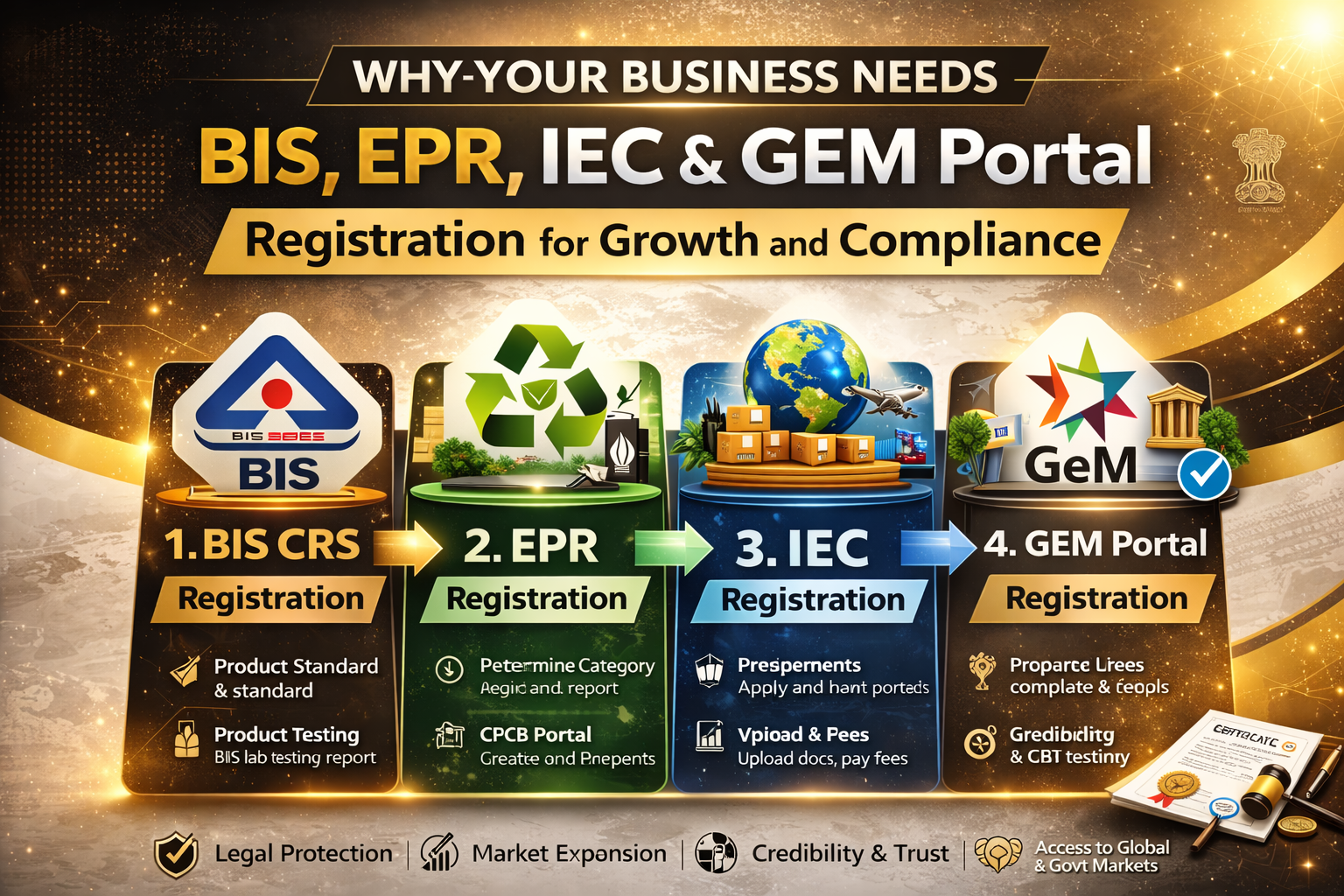
Why Your Business Needs BIS, EPR, IEC & GEM Portal Registration for Growth and Compliance
In today’s fast-changing business environment, compliance is no longer optional — it is a necessity. Whether you are a manufacturer, importer, exporter, startup, or service provider, having the right registrations not only ensures legal safety but also creates opportunities for business growth.
BIS, EPR, IEC, and GEM Portal Registration are four essential certifications that help businesses operate smoothly, expand markets, and build credibility in India and globally.
Let’s understand why each of these registrations is important for your business success.
1. BIS Registration – Ensuring Product Quality & Market Trust
BIS (Bureau of Indian Standards) under the Compulsory Registration Scheme (CRS) is mandatory for specific electronic and electrical products.
Why Your Business Needs BIS CRS:
✔ Mandatory compliance for selling notified products in India
✔ Prevents legal penalties and product seizure
✔ Builds consumer trust and brand credibility
✔ Required for import clearance of regulated products
✔ Enhances product acceptance in domestic markets
Without BIS certification, many products cannot legally enter or be sold in the Indian market. For manufacturers and importers, this registration is a foundation for smooth operations.
2. EPR Registration – Strengthening Environmental Responsibility
EPR (Extended Producer Responsibility) ensures that businesses take responsibility for waste management of their products, especially plastic, e-waste, batteries, and packaging materials.
Why EPR is Important for Growth:
✔ Legal compliance under environmental laws
✔ Avoids heavy penalties and regulatory action
✔ Improves brand image as an eco-friendly company
✔ Supports sustainable business practices
✔ Builds trust among environmentally conscious consumers
In 2026, environmental compliance has become a key factor for investors, customers, and regulators. EPR registration positions your business as responsible and future-ready.
3. IEC Registration – Gateway to International Trade
IEC (Import Export Code) is mandatory for any business involved in importing or exporting goods or services.
Why IEC is Essential:
✔ Required for customs clearance
✔ Enables international transactions
✔ Necessary for receiving foreign currency payments
✔ Expands global market opportunities
✔ Supports e-commerce export growth
Without IEC, businesses cannot legally engage in cross-border trade. It is the first step toward entering global markets and increasing revenue streams.
4. GEM Portal Registration – Access to Government Procurement
GEM (Government e-Marketplace) allows businesses to sell products and services directly to government departments.
Why GEM Registration Drives Growth:
✔ Access to large government tenders
✔ Transparent and digital procurement process
✔ Faster and secure payments
✔ Special benefits for MSMEs and startups
✔ Opportunity to scale business nationally
Government procurement is one of the largest markets in India. GEM registration opens the door to stable, high-volume buyers.
How These Registrations Support Business Growth
When combined, BIS, EPR, IEC, and GEM registration create a strong compliance framework that enables:
✔ Legal protection
✔ Market expansion
✔ Increased credibility
✔ Access to domestic and international markets
✔ Competitive advantage
Businesses that prioritize compliance grow faster because they avoid operational interruptions, penalties, and reputational risks.
Compliance is Not a Cost — It’s an Investment
Many businesses see registrations as a formality. However, in reality, they are strategic tools that:
- Improve brand positioning
- Increase customer confidence
- Enable new revenue streams
- Reduce regulatory risk
- Strengthen long-term sustainability
Companies that ignore compliance often face delays, penalties, or lost opportunities.
Final Thoughts
If your business is involved in manufacturing, importing, exporting, waste-generating products, or government supply, obtaining BIS, EPR, IEC, and GEM registration is not just about compliance — it’s about growth, credibility, and long-term success.
By securing these registrations, you build a legally strong, market-ready, and future-proof business.