
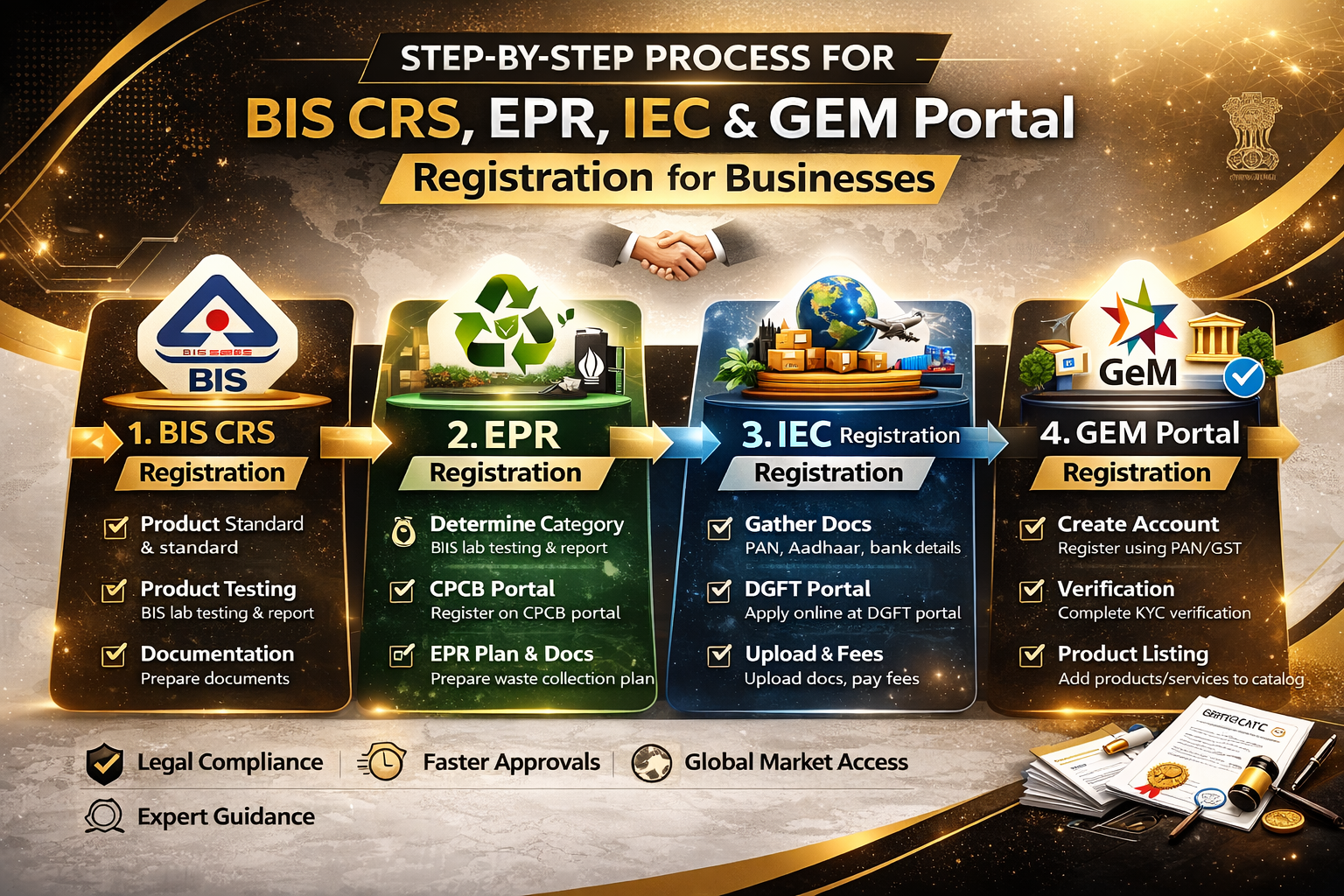
Step-by-Step Process for BIS CRS, EPR, IEC and GEM Registration for Businesses
In today’s regulatory environment, businesses in India must comply with various certifications and registrations before entering the market or expanding operations. Whether you are a manufacturer, importer, exporter, or service provider, understanding the step-by-step process for BIS CRS, EPR, IEC, and GEM Registration can save time, reduce errors, and ensure smooth approvals.
This guide explains each process in a simple and structured manner.
1. Step-by-Step Process for BIS CRS Registration
BIS CRS (Compulsory Registration Scheme) is mandatory for specific electronic and IT products before selling them in India.
Step 1: Identify Applicable Product Standard
- Determine whether your product falls under mandatory BIS CRS.
- Identify the relevant Indian Standard (IS code).
Step 2: Product Testing
- Send product samples to a BIS-recognized laboratory.
- Obtain a valid test report as per the applicable IS standard.
Step 3: Documentation Preparation
- Manufacturer details
- Factory address proof
- Trademark certificate (if applicable)
- Authorization letter (for Indian Representative, if foreign manufacturer)
Step 4: Online Application Submission
- Submit the application on the BIS portal.
- Upload test reports and required documents.
Step 5: Scrutiny & Approval
- BIS verifies documents.
- Upon approval, registration number is issued.
- Product marking with BIS Standard Mark becomes mandatory.
2. Step-by-Step Process for EPR Registration
EPR (Extended Producer Responsibility) ensures producers are responsible for waste management of their products.
Step 1: Determine Category
-
Identify whether you fall under Plastic Waste, E-Waste, Battery Waste, etc.
Step 2: Registration on CPCB Portal
-
Register on the Central Pollution Control Board (CPCB) portal.
Step 3: Prepare EPR Plan
- Waste collection strategy
- Recycling agreements
- Target compliance details
Step 4: Documentation Submission
- GST certificate
- PAN details
- Company incorporation documents
- Product details
Step 5: Approval & EPR Certificate
- Authorities review the plan.
- Upon approval, EPR Registration Certificate is issued.
- Annual returns and compliance reporting are mandatory.
3. Step-by-Step Process for IEC Registration
IEC (Import Export Code) is mandatory for businesses involved in international trade.
Step 1: Gather Required Documents
- PAN of business
- Aadhaar (for verification)
- Business address proof
- Bank details
Step 2: Apply on DGFT Portal
- Create login on DGFT website.
- Fill IEC application form online.
Step 3: Upload Documents
- Upload scanned copies.
- Pay government fees.
Step 4: Verification & Issuance
- Application is verified digitally.
- IEC number is generated electronically.
- No physical certificate is required.
4. Step-by-Step Process for GEM Portal Registration
GEM (Government e-Marketplace) allows businesses to supply goods/services to government departments.
Step 1: Account Creation
- Visit GeM portal.
- Create seller account using Aadhaar/PAN/GST.
Step 2: Business Verification
- Complete KYC verification.
- Validate bank account details.
Step 3: Product/Service Listing
- Upload product catalog.
- Add pricing, specifications, and images.
Step 4: Brand Approval (If Required)
-
Apply for brand listing approval if applicable.
Step 5: Bid Participation
- Participate in tenders and direct purchase orders.
- Manage orders and payments through portal.
Why These Registrations Are Important
✔ Legal compliance
✔ Avoid penalties and delays
✔ Improve brand credibility
✔ Expand into global markets
✔ Access government procurement opportunities
Final Thoughts
Understanding the correct process for BIS CRS, EPR, IEC, and GEM Registration ensures faster approvals and reduces rejection risks. Each registration requires accurate documentation, proper filing, and compliance monitoring.
Businesses that follow a structured approach or seek expert guidance can complete the process smoothly and focus on growth rather than regulatory hurdles.